


Join StarRocks Community on Slack
Connect on SlackReal-time analytics has become the engine behind modern digital experiences, powering instant dashboards, interactive analytics, personalized recommendations, and operational decisioning.
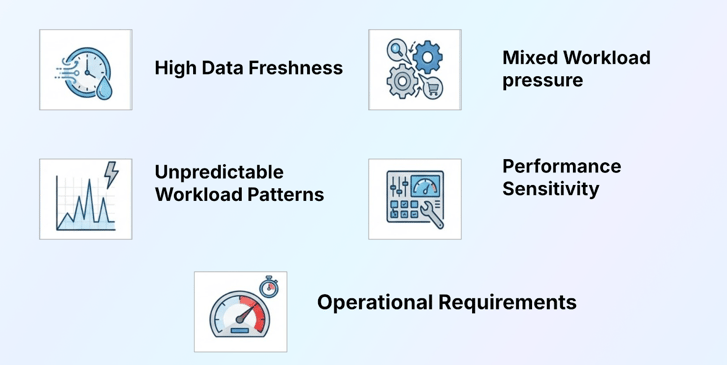
Yet as organizations move deeper into real-time workloads, one challenge consistently rises above the rest: Spikes in concurrency, mixed workloads, bursty traffic, and constantly changing data models all put pressure on traditional scaling approaches. Over-provisioning becomes expensive, under-provisioning creates latency spikes, and manual scaling turns into a full-time job.
This is exactly the problem Smarter Scaling in CelerData Cloud BYOC is built to solve.
In this blog, we’ll walk through the key innovations behind Smarter Scaling and how they uniquely support high-performance, cost-efficient real-time workloads, without creating the burden on operations.
Current challenges with Scaling Real-Time Workloads
Most cloud data systems were designed for steady, predictable workloads: fixed dashboards, nightly batch loads, moderate concurrency, stable usage pattern; This is why many organizations end up with challenges around:
- oversizing clusters “just in case”
- reacting to incidents after performance dips
- spending days tuning capacity manually
- fighting noisy-neighbor issues inside shared compute pools
However, today’s analytics platforms need concurrency, latencies and mixed loads are different, so they need ‘intelligent’ ways of scaling.
Introducing Smarter Scaling in CelerData Cloud BYOC
Smarter Scaling is a set of capabilities in CelerData Cloud (BYOC) that automatically adjusts compute resources to match real-time demand to minimize latency impact and zero operational friction. Here’s what makes these features very powerful.
1) Multiple Scaling Modes
Not all workloads behave the same. CelerData lets you choose how your cluster scales based on your business rhythms:
Manual Scaling
Perfect for complete control or when infrastructure changes must go through change management.
Scheduled Scaling
Ideal for predictable patterns that organizations and teams are already aware of, for example: Morning dashboard rush, end-of-day reporting windows, weekly ETL cycles. An 8-node cluster can scale to 12 nodes right when demand hits, not after the spike has already hurt performance.
Automated Policy-Based Scaling
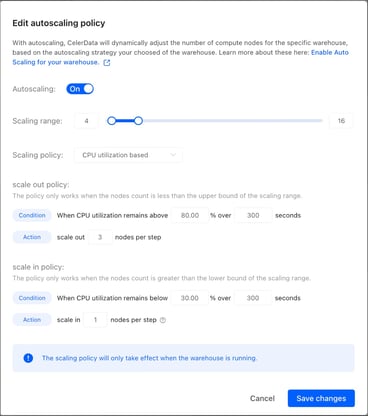
React automatically to workloads happening on the cluster by watching: CPU utilization, Query concurrency, Queue length & Latency SLOs. This gives organizations fine-grained tuning without constant SRE intervention.
2) Group-Aware Scaling: True Workload Isolation
In most data systems, all workloads share the same compute pool, invariably leading to noisy-neighbor issues. A big analytical query slows down dashboards. A heavy ETL load affects customer-facing Latency.
Not in CelerData.
Group deployments allow you to isolate workloads into independent pools, each with its own scaling policy. For example,
- Dashboards Group → scales based on concurrency
- Analytical queries Group → scales based on CPU
- Streaming ingestion Group → remains stable with tight SLOs
This means each workload gets just the right amount of compute at just the right time, without tripping over each other.
3) Fast Node Warm-Up for Real-Time Needs
Scaling is only useful if the newly added nodes are able to become productive and contribute to the system's performance quickly. However, most database and query engines typically require a significant amount of time, often several minutes or more, before a new computer can effectively warm up and meaningfully improve overall performance. This delay diminishes the utility of scaling.
CelerData's foundational architecture with Cache Replicas is fundamentally different from these traditional engines. Because its system is designed with efficient metadata sharing across nodes and utilizes external storage for data, new compute nodes can warm up exceptionally fast.
This rapid activation of new nodes makes the process of horizontal scaling practical and highly effective, especially for systems that demand real-time responsiveness and elasticity.
4) Guardrails That Prevent Thrashing
Autoscaling systems without guardrails often oscillate (scale up, scale down, repeat). This leads to instability and wasted cost. CelerData Smarter Scaling has capabilities for
- cooldown windows
- minimum & maximum node counts
- stability thresholds
5) Workload-Specific Scaling Policies
Each workload has a different “stress signature.” for example, Dashboards are usually concurrency-driven, while adhoc analytics are CPU driven and streaming ingestion is latency-driven . CelerData lets you assign different policies to different workloads e.g.:
- “Scale when concurrency hits 150”
- “Scale when CPU averages above 75%”
- “Scale out if queue grows beyond 1 second”
- “Do not scale ingestion group to protect pipeline stability”
This is a level of flexibility that traditional warehouses simply don’t offer.
Conclusion
A truly effective real-time analytics solution needs more than just a fast processing engine; it demands a platform capable of rapid reaction. This means the solution must not only process high-velocity, high-volume streaming data with ultra-low latency, but it must also integrate seamlessly with business processes and operational systems to enable immediate, automated responses based on the insights derived.
CelerData Cloud BYOC’s Smarter Scaling brings together:
- elasticity
- workload isolation
- intelligence
- cost efficiency
- and cloud-native simplicity
…built on top of the StarRocks engine’s already exceptional performance.
If you’re looking to keep your real-time analytics system fast, stable, and cost-efficient, without drowning in operational work, Smarter Scaling is designed for exactly that.
Get Started Today
Ready to bring real-time analytics into your own cloud environment? With BYOC, you can start faster than ever:
- Visit our CelerData Cloud BYOC
- Sign up for a free trial or connect with our team